Signing Queue
Lead Product Manager
Brief
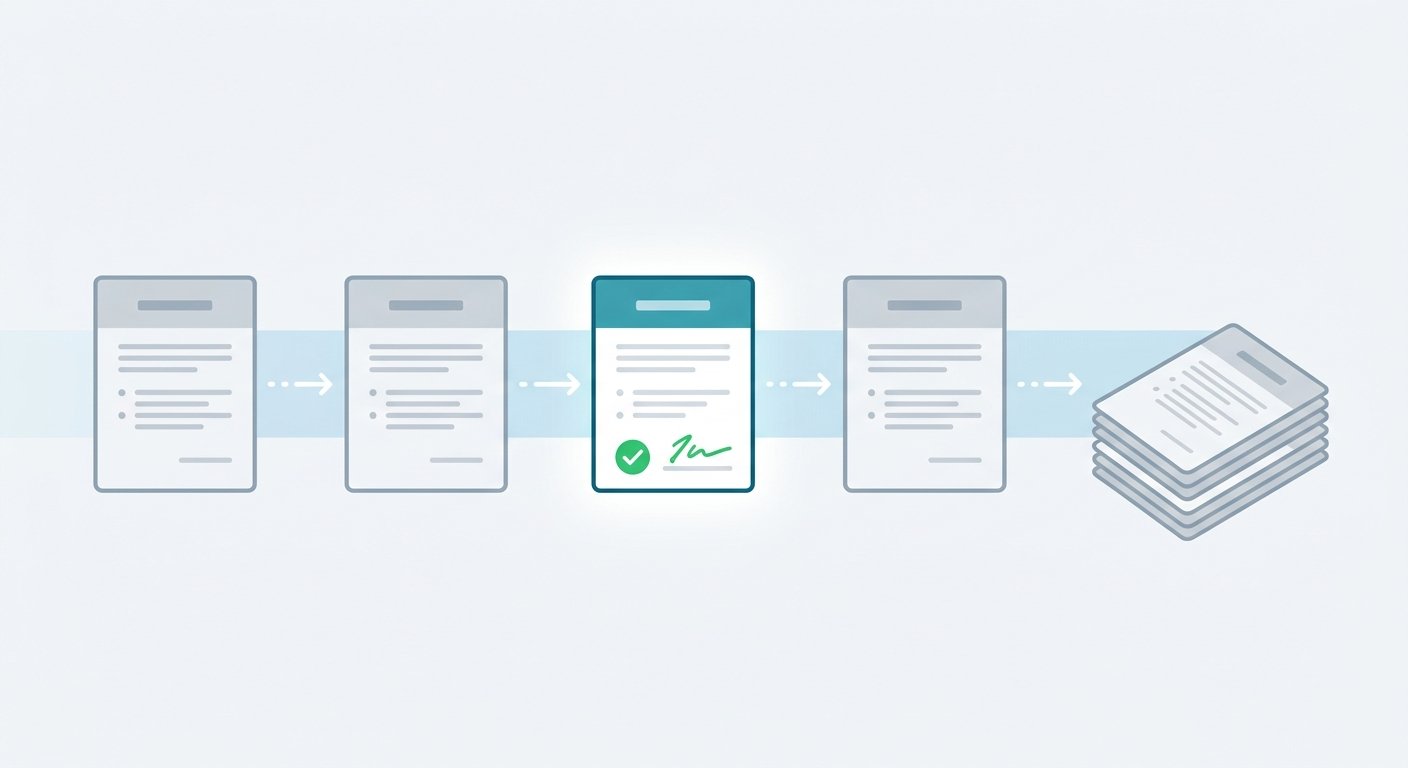
Signing contracts was a stop-start process. People would sign one, leave the tool, and forget the three others sitting in their queue, so backlogs grew and deals stalled. Signing Queue fixed the flow itself. Once you sign a contract, it automatically surfaces the others waiting on your signature and lines them up to clear one by one. Paired with Contract Context, which pulls the key details of each contract right onto the signing page, users no longer had to dig through documents to feel sure about what they were signing. Together the two cut signing dropoff and helped users work down their unsigned backlog instead of letting it pile up.
What I Did
- Ran discovery with customers and SMEs to understand the backlog problem and how people were working around it today.
- Partnered with Engineering and Design to shape the feature and take it from idea to launch.
- Worked with CSMs and Marketing on rollout, gathering early feedback and tracking real usage.
Results
45%
Reduction in unsigned contract backlog
35%
Reduction of drop-off while signing
1000+
Contract signed in queue
Tools & Skills
Full breakdown
The problem I was handed This started as a direction from leadership: make it possible to sign multiple contracts in one flow. Before building anything, I ran discovery with customers and SMEs, including our own CEO, who's a power user of the product. What I learned reframed the problem. Every B2B SaaS deal involves a stack of contracts, a SaaS agreement, an order form, NDAs, and so on. They all get sent to the same signatory, but each one lands as a separate signing request. That fragmentation had a cost: with contracts arriving as scattered individual requests, some would fall through the cracks and go unsigned, stalling the deals that depended on them. Users were coping by opening every request in its own browser tab and working through them one at a time. I also learned the primary persona was C-suite and senior executives, the people signing the most and with the least patience for friction.
Framing the problem and shaping a solution The workaround users had invented was a symptom of something bigger. When I looked at the data, there was a significant backlog of unsigned contracts sitting in the system, real proof that contracts were slipping through the cracks and deals were stalling because of it. That gave the project a clear commercial stake, not just a UX one. From there I worked with design and engineering to shape a solution. We took cues from the workaround users had built for themselves, and from Slack's catch-up pattern, and landed on a queue: sign one contract, get moved straight to the next, and work through the whole stack without ever leaving the flow.
The signal we'd planned for We shipped v1 and watched usage in Amplitude, and a pattern showed up fast. Users were dropping out after signing two contracts, even when they had more still pending. Interviews told us why: people didn't have enough context on each contract to sign it confidently, so rather than sign blind, they bailed. We'd anticipated exactly this and had an enhancement on the roadmap called Contract Context, which surfaces the key details of a contract directly on the signing page. It was originally slated for later, in v3, but the data was telling us it was the thing standing between users and the full flow, so we pivoted and pulled it forward. Instead of leaving the flow to go dig for information, signers now get everything they need to commit right where they are.
The results Once Contract Context shipped, the numbers moved. We saw a 45% reduction in the unsigned contract backlog and a 35% cut in signing dropoff. Beyond the metrics, we got strong feedback from senior stakeholders on the customer side, and it turned sentiment with a few accounts that had been difficult. The feature is still live and still doing this work today.